New — check if your vessel can carry more deadweight Carry more deadweight? Try it →

ShipLCOM 3.0 — Loading Instrument

The loading computer built by naval architects.

ShipLCOM reproduces, for any loading condition the master builds, the same calculations that are contained in the ship's approved trim and stability booklet — and answers immediately whether the condition is acceptable.

2003first delivery
250+ships worldwide
8class societies
3.0current release
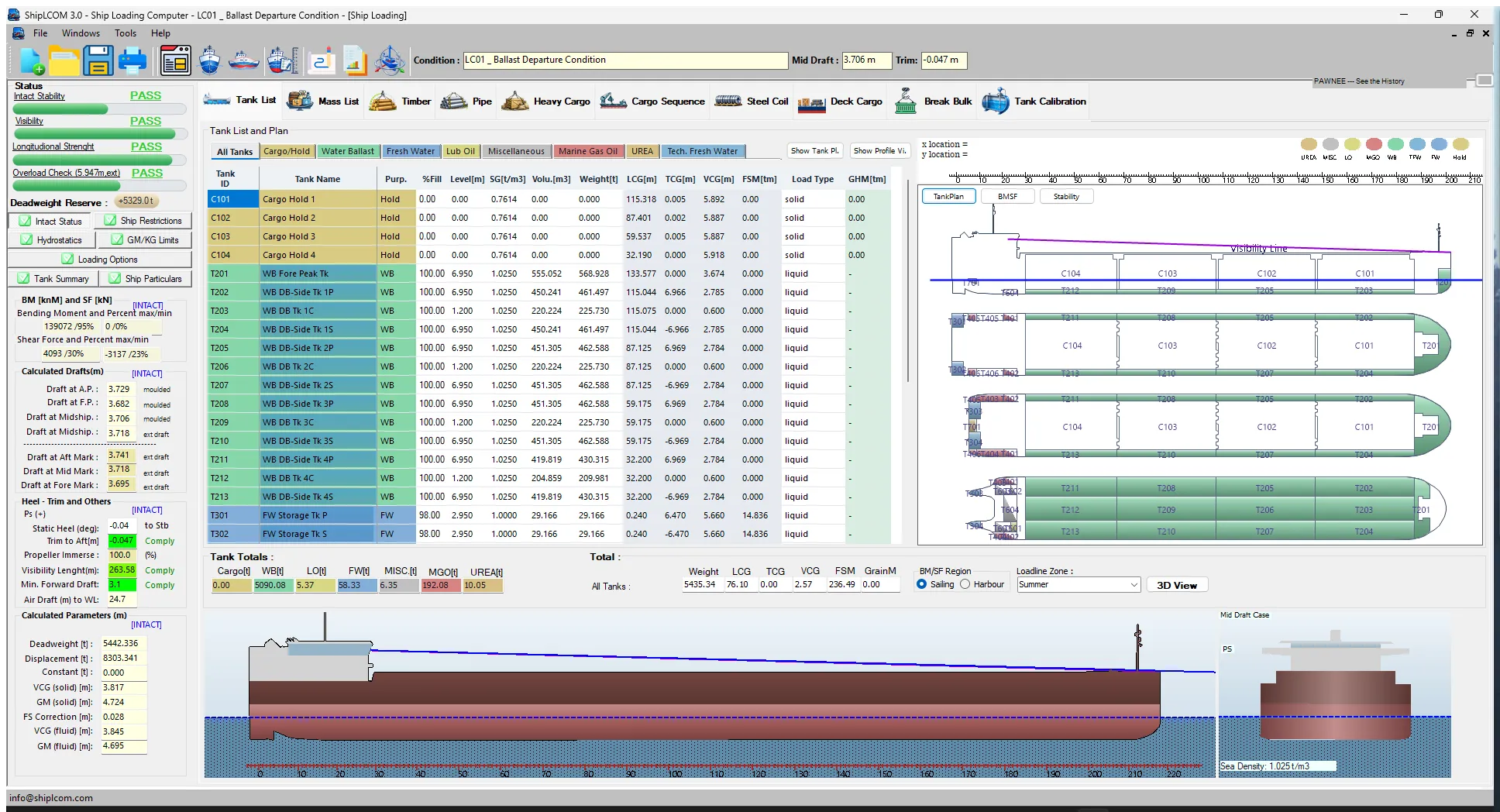
ShipLCOM 3.0 main window — tank list, tank plan, profile view and the status column
Intact Stability

Every criterion of the selected stability code passes — areas under the GZ curve, GM, maximum GZ and the weather criterion.

Longitudinal Strength

Shear force and bending moment inside the class limits at every station, on harbour or seagoing envelopes.

Overload Check

The draft stays within the load line of the selected seasonal zone.

Visibility

The blind sector ahead of the bridge stays within the SOLAS limit — recalculated the moment deck cargo is attached.

Modules

Everything the condition has to pass, in one program.

Modules follow the trade of the vessel — bulk carriers, general cargo and multipurpose ships, container feeders, steel and project cargo carriers, tankers.

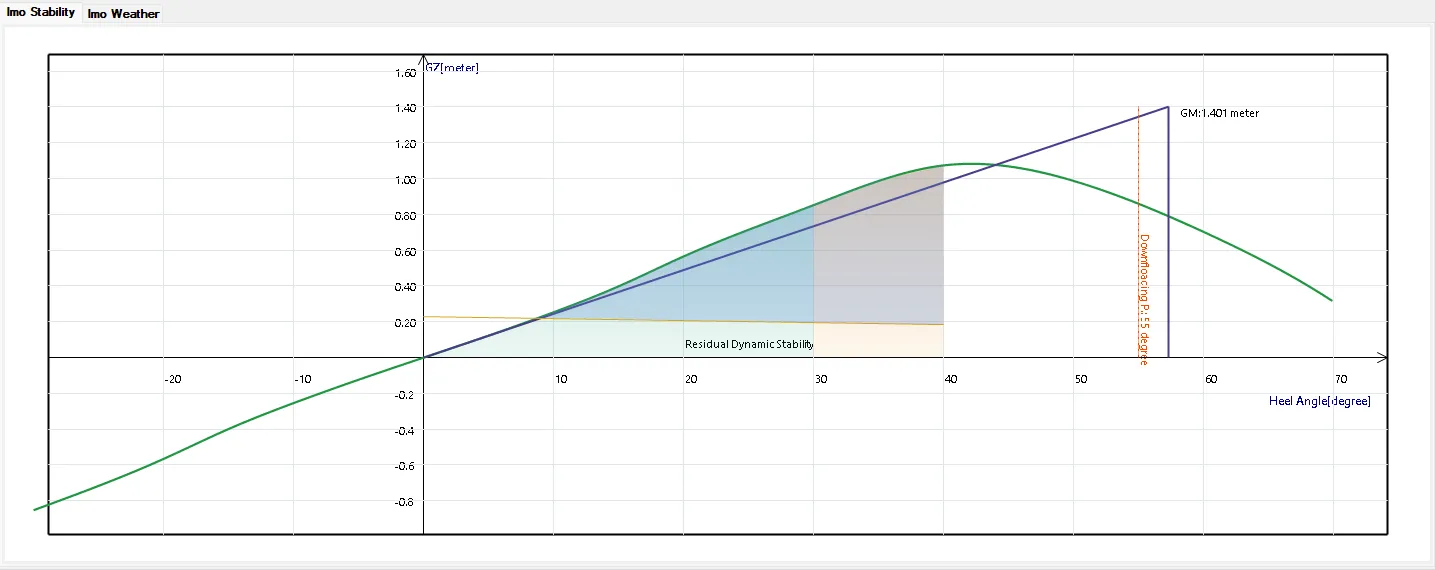
GZ righting-lever curve with GM tangent, criteria areas and downflooding angle
Results

Intact stability & weather criterion

GZ curve with the GM tangent, the criteria areas and the downflooding angle; every rule of the selected code — 2008 IS Code, grain, timber or a ship-specific set — listed with its actual value, its limit and PASS / FAIL. The severe wind and rolling criterion is evaluated with the real lateral silhouette, including attached deck cargo.

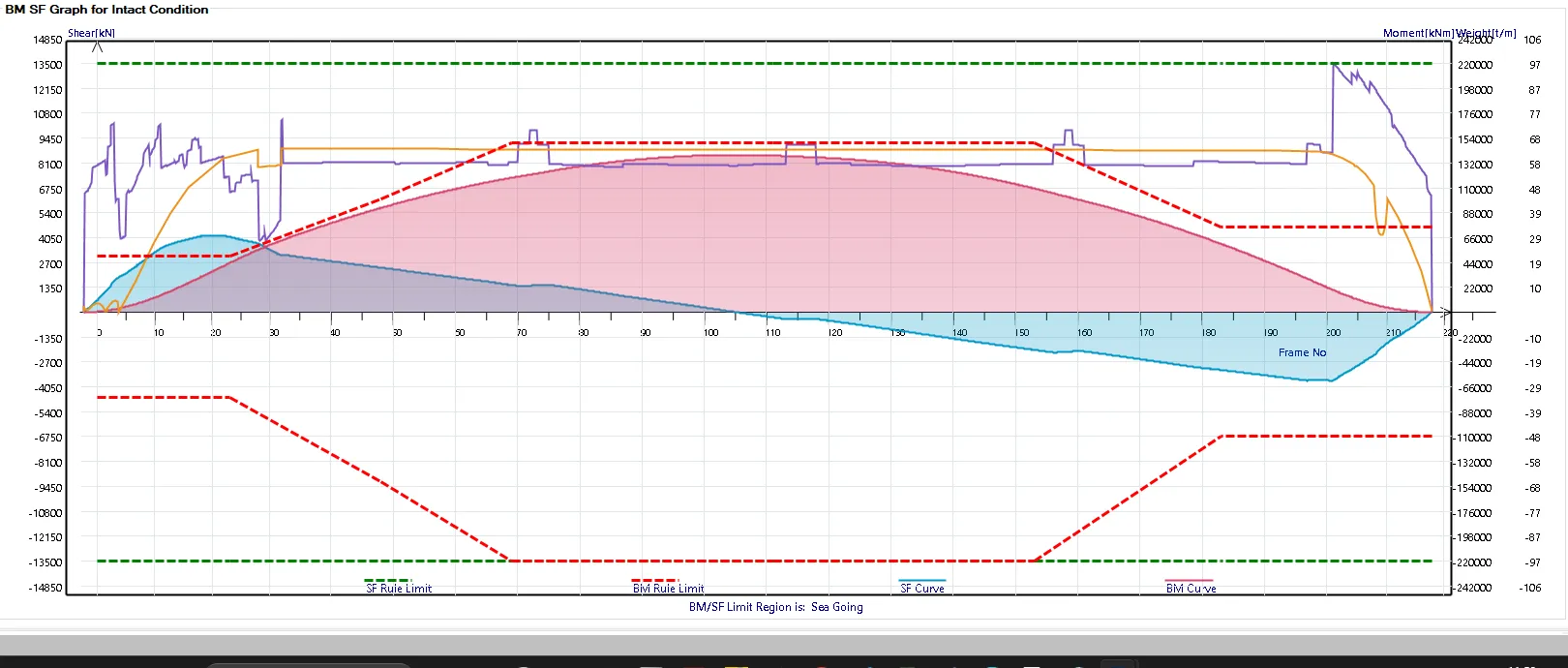
Shear force and bending moment curves against the rule limit envelopes
Results

Longitudinal strength (BM / SF)

Still-water shear force and bending moment station by station against the class limit envelopes, in harbour and seagoing sets. Peaks are reported both as absolute values and as a percentage of what is allowed at that frame — the figure that actually decides the condition.

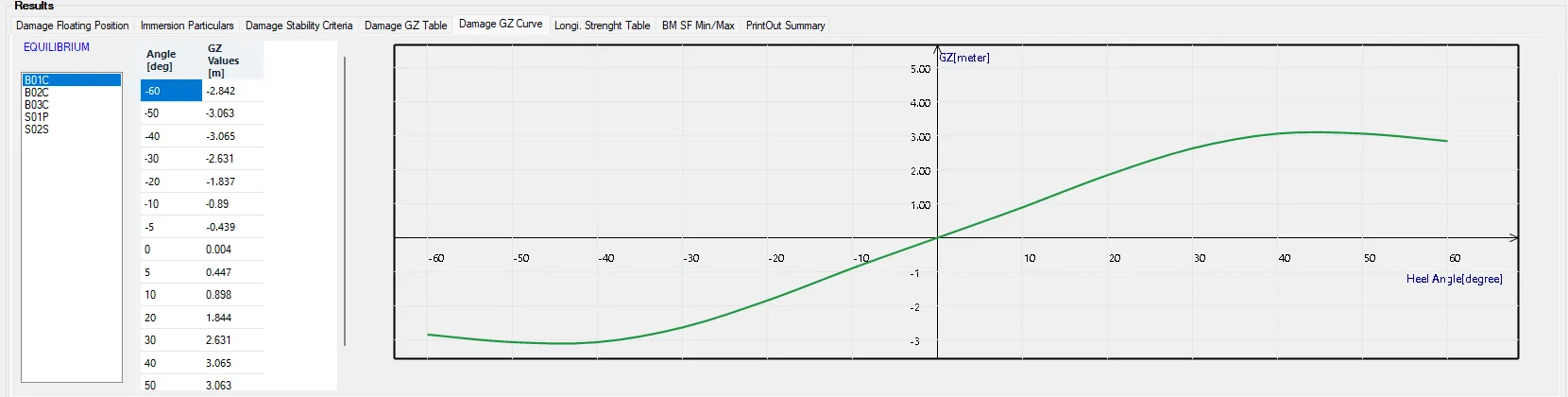
Residual GZ curve of the flooded ship with the damage case list
Results

Damage stability

The approved damage cases of the ship, flooded by the lost-buoyancy method — optionally balanced directly on the 3D hull. Floating position, residual GZ and the applicable criteria set (SOLAS 2009, MARPOL, MSC.235(82) or the IACS UR S17 flooded-hold strength check) per case.

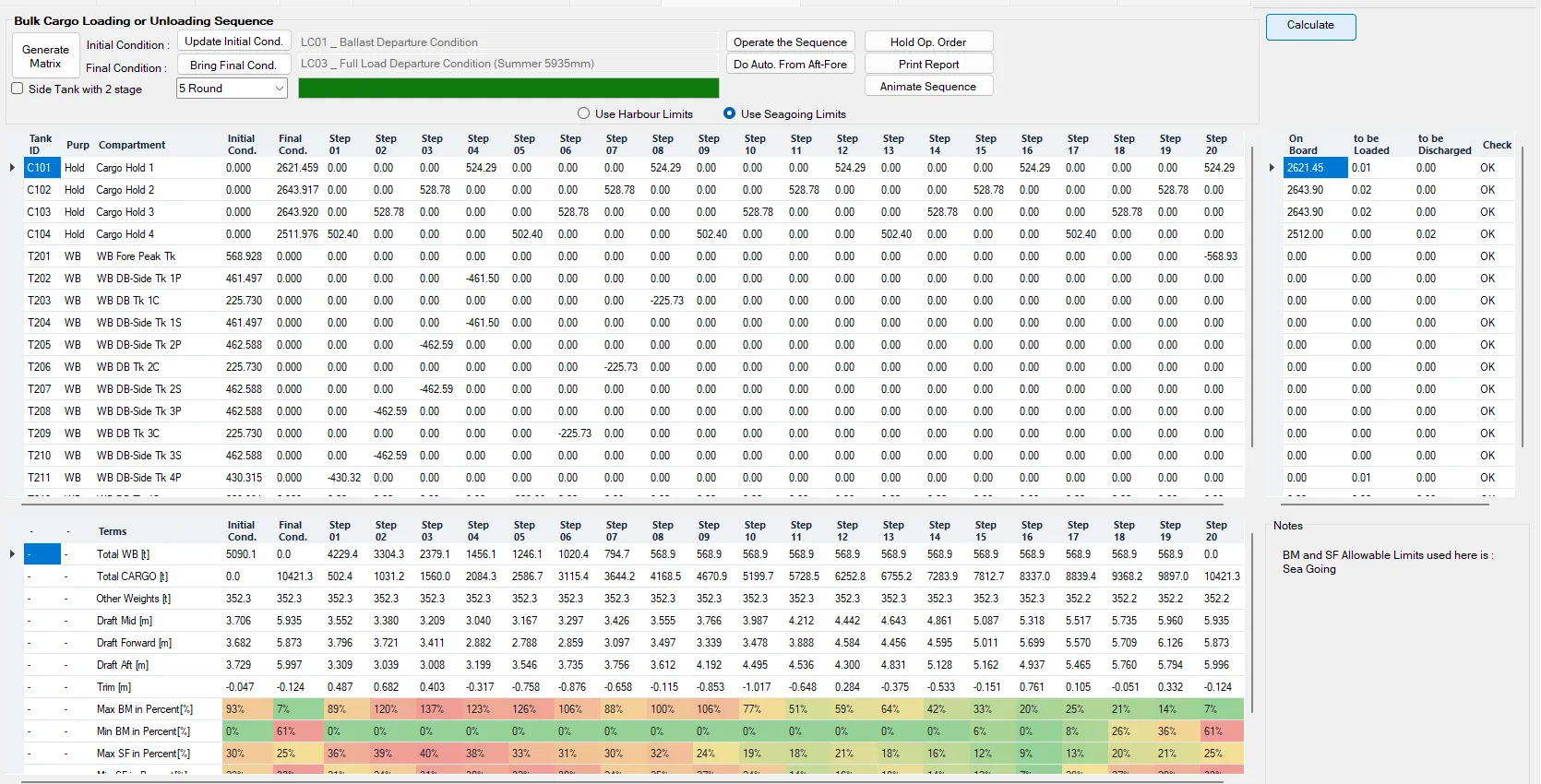
Bulk cargo loading sequence matrix with strength percentages per step
Operations

Loading / unloading sequence

The cargo operation planned as steps, with drafts, trim and the BM / SF percentages calculated at every stage — because the highest bending moment usually occurs between the ballast and the loaded condition, not at the end. The plan can be agreed with the terminal before loading starts.

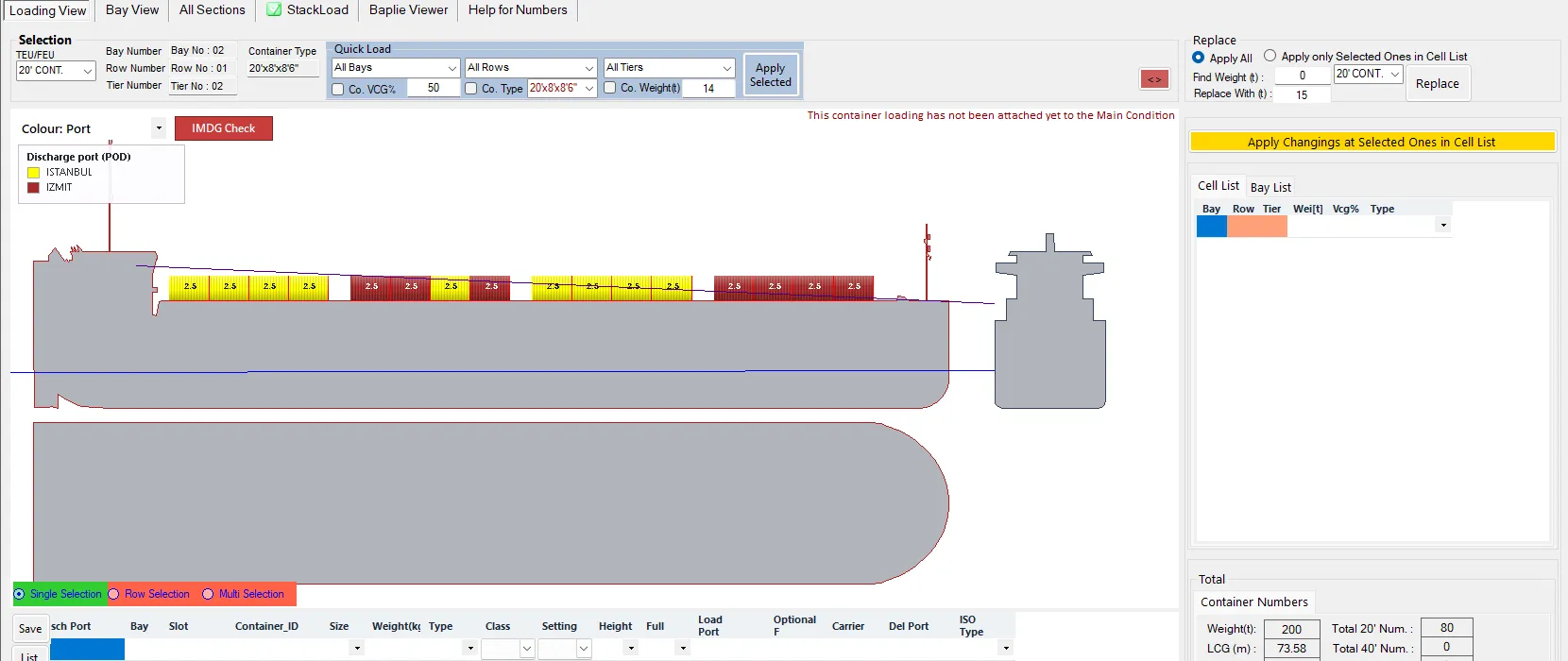
Container loading view coloured by port of discharge
Cargo

Containers & BAPLIE

Bay / row / tier cell plan with colour modes, Quick Load, stack load check and IMDG segregation. BAPLIE files are imported and exported, and the deck stow enters the visibility check the moment it is attached.

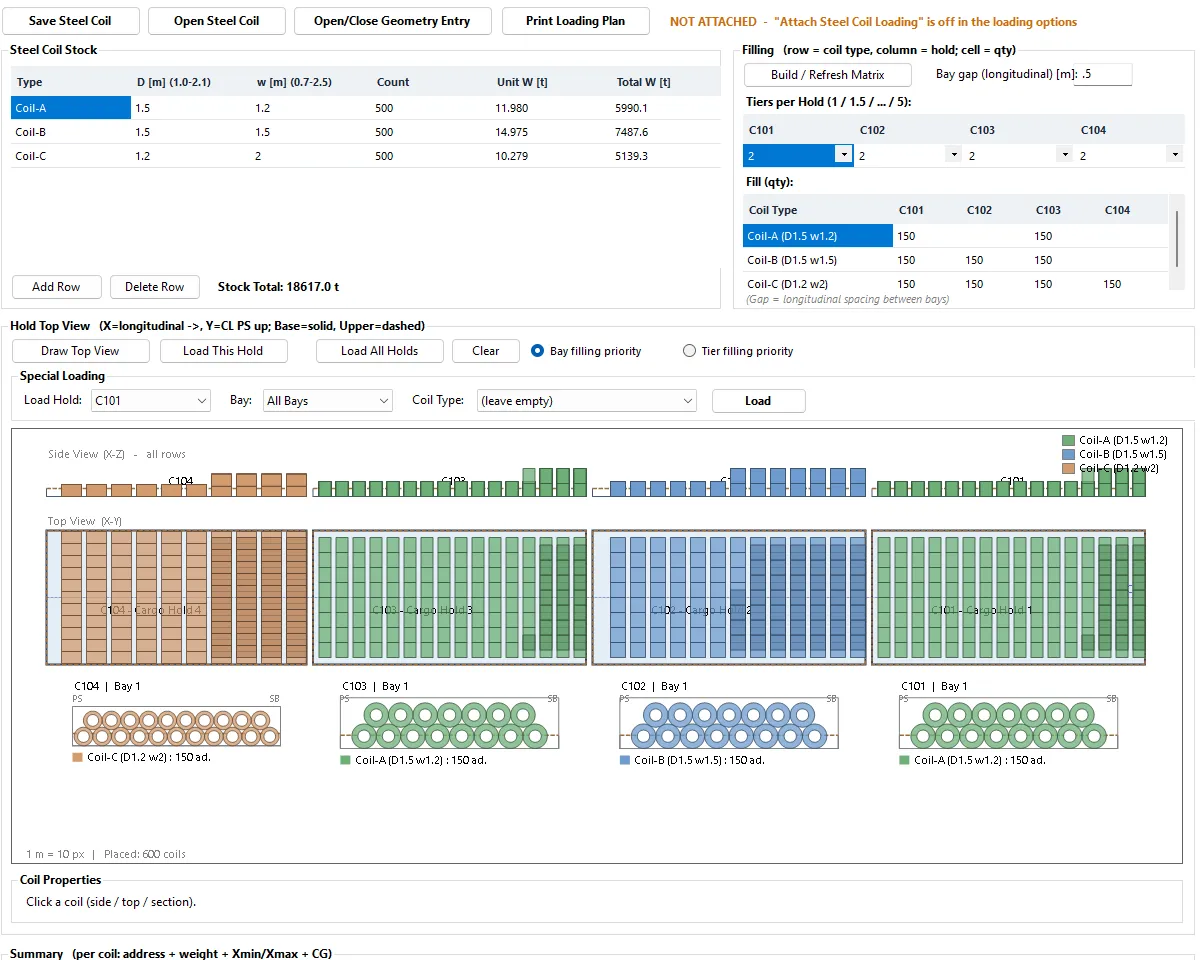
Steel coil module — stock, filling matrix and the stow drawn in three views
Cargo

Steel coil & tank top strength

Coils stowed bay by bay and tier by tier, with dunnage, and the line load each coil puts on the double bottom checked against the permissible deck load of the hold. Deck cargo, break bulk, heavy cargo, timber and pipe have their own 3D loaders on the same pattern.
Beyond the loading case

From the 3D model to the signed report.

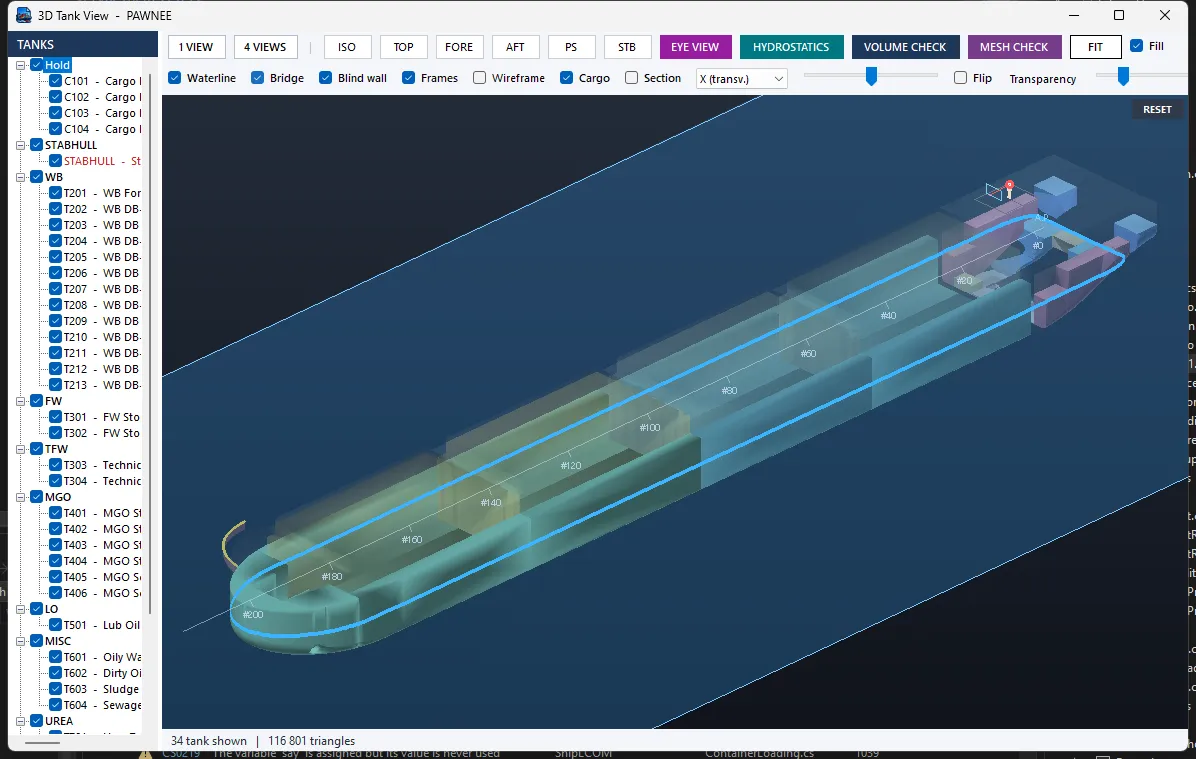
3D tank view of the hull with the waterline plane and tank tree
Tools

3D model of hull, tanks and cargo

The hull, every tank at its current level and the attached cargo in three dimensions — with hydrostatics computed directly from the geometry, an eye view from the conning position for the visibility check, and volume and mesh checks for new ship data.

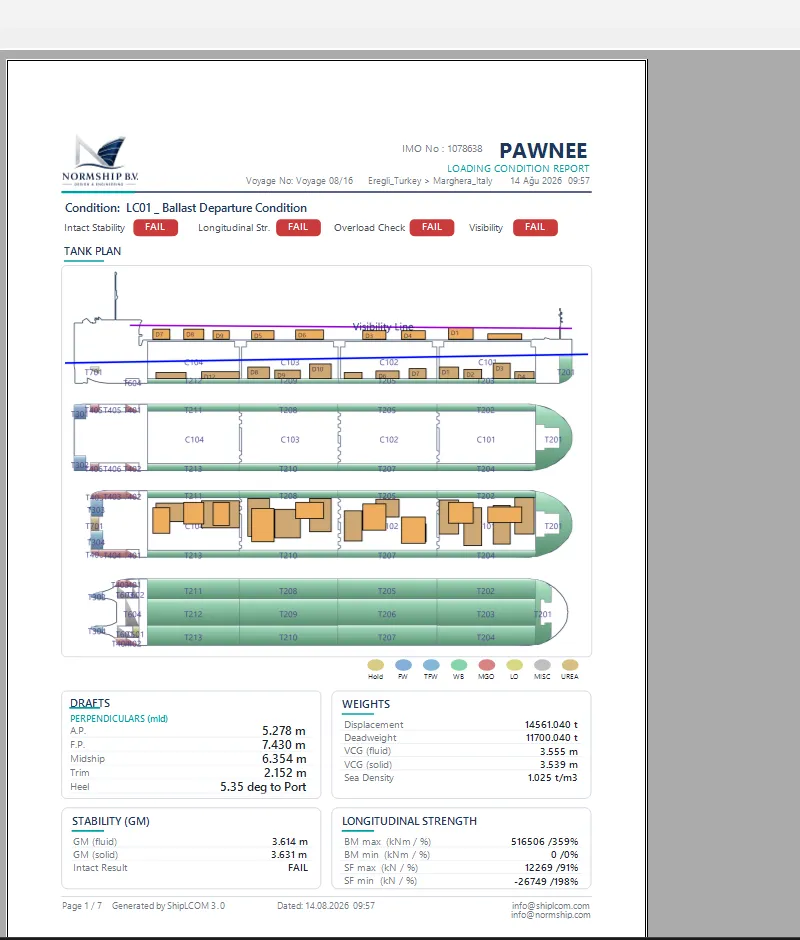
Print preview of the Loading Case 2.0 report with the tank plan and the four verdict badges
Reports

Class-ready documents

Loading Case 2.0 and Cargo Plan 2.0 reports, the grain form, the securing calculation, draft survey and calibration tables. The cover page carries the ship, the voyage and the four verdicts as badges — the program never silently accepts a bad condition.

Grain in bulk

The full International Grain Code calculation — trimmed, untrimmed, partially untrimmed and secured stows, each with its own volumetric heeling moment — and the grain form printed for the authorities.

Lashing / cargo securing

IMO CSS Code Annex 13 balances — transverse sliding, tipping, longitudinal sliding — for every deck cargo unit, with a separate signed securing calculation.

Tank calibration

Calibration tables produced from the ship’s own 3D geometry, for sounding pipe or remote sensor, with live volume read-out.

Draft survey

Cargo quantity from the drafts at the marks: perpendicular and hog / sag corrections, trim and density corrections, deductibles and the ship’s constant.

Onboard manual

A searchable manual is part of the program — every topic printable on board, kept with the ship database.

Approvals

Approved by eight classification societies.

ShipLCOM installations are classified under IACS UR L5 — up to Type 3, with damage stability by direct calculation. Every installation is ship-specific: hydrostatics, cross curves, tank calibration, limit curves and strength limits are taken from the vessel's approved documentation, delivered with test conditions and the class approval certificate.

ABS
BV
DNV
KR
LR
NK
RINA
TL

The regulations behind it

  • SOLAS II-1 Reg. 5 / 5-1 — stability information the master can use
  • SOLAS XII Reg. 11 — loading instrument for bulk carriers of 150 m and upwards
  • 2008 IS Code (MSC.267(85)) — the intact stability criteria
  • International Grain Code (MSC.23(59)) — grain heeling moments and criteria
  • Load Line 1966 / 1988 Protocol — freeboard and seasonal zones — the Overload Check
  • IMO CSS Code Annex 13 — securing of non-standardised cargo
  • IACS UR L5, S11, S17 — onboard stability computers, hull girder limits, flooded-hold strength

Need a loading instrument for your vessel?

Send the vessel particulars — we'll build the installation on the ship's approved data and support the class approval, including the Ship Data and Test Case booklets.

Get a quote